Повечето хора смятат, че електрическите превозни средства са ново изобретение, но истината е много по-интересна. Електрическите превозни средства съществуват от зората на автомобила - те просто направиха едновековно отклонение, преди да се върнат на преден план.
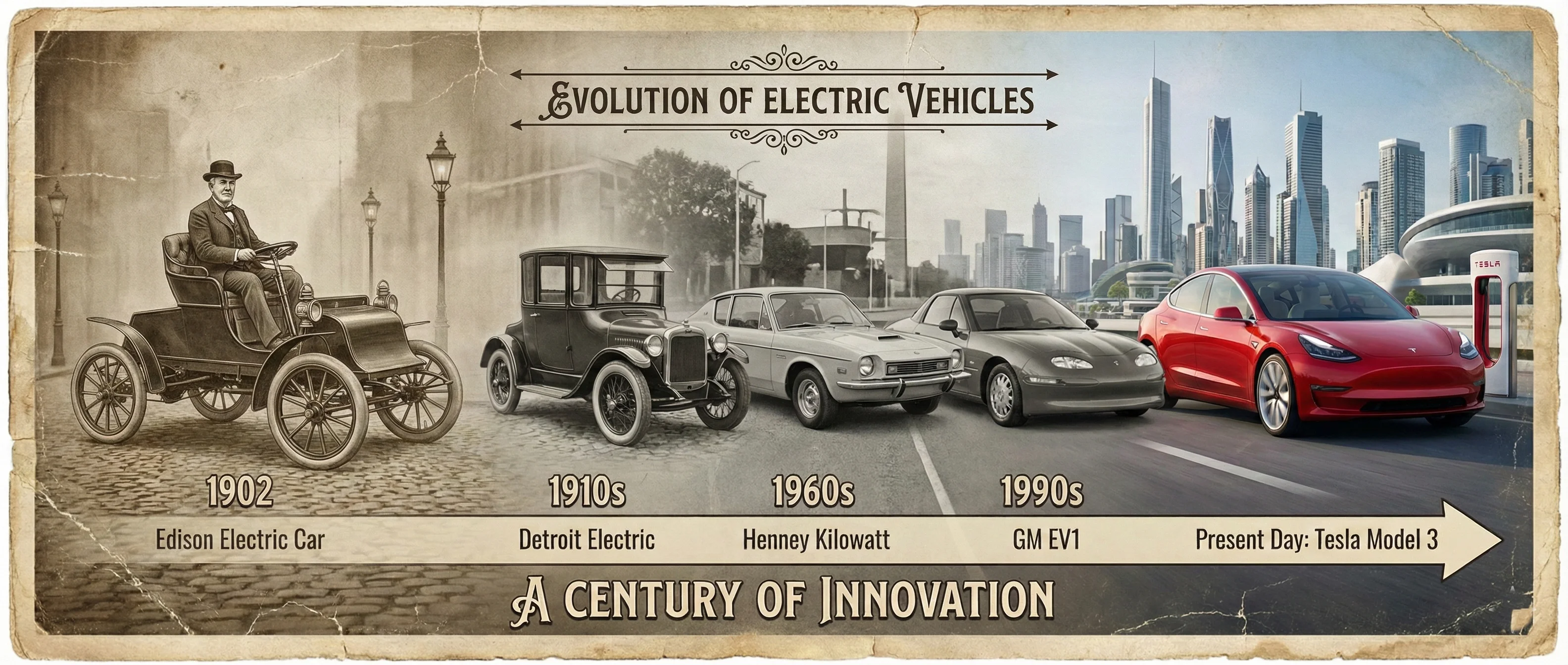
Времева Линия на EV
The Electric Age Begins
In the 1830s-1840s, inventors in the Netherlands, Hungary, and the United States experimented with small-scale electric vehicles.
By the 1890s, EVs were becoming practical and popular. They were clean, quiet, easy to operate, and didn't require the hand-crank starting of gasoline vehicles.
- 1890: William Morrison of Des Moines, Iowa, creates the first practical electric car in the United States
- 1897: Electric taxicabs appear in New York City
- 1899: An electric vehicle breaks the 100 km/h (62 mph) speed barrier
- 1900: EVs account for about one-third of all vehicles on the road
EVs Peak in Popularity
The early 1900s were actually the golden age for electric vehicles. They were preferred by many drivers for their ease of use and reliability.
- Thomas Edison and Henry Ford were friends; Edison worked on improving EV batteries while Ford refined the gasoline car
- EVs were particularly popular with women drivers as they didn't require dangerous hand-crank starting
- Major manufacturers like Baker Electric and Detroit Electric produced thousands of EVs
- By 1912, about 34,000 electric cars were registered in the United States
The Dark Ages for EVs
Several factors led to the decline of electric vehicles and the dominance of gasoline cars:
- Electric starter: Charles Kettering invented the electric starter for gas cars in 1912, eliminating one of EVs' main advantages
- Cheap oil: Discovery of abundant oil in Texas and Oklahoma made gasoline very inexpensive
- Better roads: Improved road infrastructure favored the longer range of gas vehicles
- Mass production: Henry Ford's assembly line made gas cars affordable for the masses
- By 1935: Electric cars had virtually disappeared from roads
First Revival Attempts
The 1970s oil crisis sparked renewed interest in alternatives to gasoline.
- Several manufacturers produced limited runs of electric vehicles
- Most had very limited range (40-60 miles) and used lead-acid batteries
- High costs and poor performance kept them from mainstream adoption
- The CitiCar became the most-produced EV of the era (about 4,400 units)
Modern EVs Emerge
California's Zero Emission Vehicle (ZEV) mandate pushed automakers to develop practical EVs.
GM released the EV1 in 1996 - the first mass-produced EV of the modern era. It was groundbreaking but ultimately cancelled in 2003.
- Toyota RAV4 EV (1997): Limited production electric SUV
- Honda EV Plus (1997): Lease-only electric vehicle
- These vehicles proved EVs could be practical but battery technology wasn't quite ready
- Most early EVs were recalled and destroyed, frustrating early adopters
The Tesla Effect
Everything changed when a Silicon Valley startup decided to build an electric sports car.
- 2008: Tesla releases the Roadster, proving EVs can be fast, sexy, and have 200+ mile range
- 2010: Nissan Leaf launches as the first mass-market modern EV (affordable but practical)
- 2010: Chevrolet Volt introduced as a plug-in hybrid
- Lithium-ion battery technology finally makes long-range EVs practical
- Consumer perception begins to shift
Mainstream Breakthrough
The 2010s saw exponential growth in EV adoption and improvements in technology.
- 2012: Tesla Model S launches, setting new standards for EVs
- 2014: BMW i3 and VW e-Golf bring EVs from established brands
- 2017: Tesla Model 3 brings Tesla technology to mass-market prices
- 2018: Audi e-tron, Jaguar I-PACE show luxury brands taking EVs seriously
- China becomes world leader in EV production and adoption
- Battery costs drop 87% from 2010 to 2019
The Electric Revolution
EVs transition from alternative to mainstream in record time.
- 2020-2021: Major automakers commit to all-electric futures
- 2022: Ford F-150 Lightning proves EVs can handle truck duties
- 2023: Global EV sales exceed 10 million units in a year
- Major manufacturers announce plans to phase out gas vehicles by 2030-2035
- EV market share exceeds 90% in Norway, showing what's possible
- Charging infrastructure expands rapidly worldwide
EVs Come Full Circle
More than 120 years after their first peak, electric vehicles are finally realizing their potential. Advanced battery technology, environmental concerns, and improved performance have aligned to make EVs not just viable, but superior to gas vehicles for most uses.

Уроци от Историята
Технологията Изисква Време
На EV им трябваше повече от век развитие на батериите, за да станат наистина практични. Литиево-йонните батерии бяха пробивът, който направи модерните EV възможни.
Инфраструктурата е Важна
Липсата на електрическа инфраструктура в селските райони помогна на бензиновите коли да доминират. Днес електричеството е навсякъде, давайки на EV фундаментално предимство.
Икономиката Задвижва Приемането
Евтиният петрол уби ранните EV. Днес скъпият петрол и падащите цени на батериите правят EV икономически превъзхождащи.
Понякога Бъдещето е Кръгово
Това, което някога е било доминиращо, после остаряло, може да стане доминиращо отново с правилната технология и обстоятелства. Електрическото задвижване беше правилният отговор през 1900 г. и е правилният отговор днес.